By Daniel
In this article
“Finish the proposal” names the outcome. “Check option B against the supplier quote, then update row 4” tells you how to start again. That difference matters when a phone call, meeting or household interruption breaks the thread of your work.
The method below works in a document, a paper notebook or a task's notes. The examples are editorial suggestions. The linked research explains why a return plan is worth trying; it does not promise a fixed productivity gain.
Leave a starting point before you switch
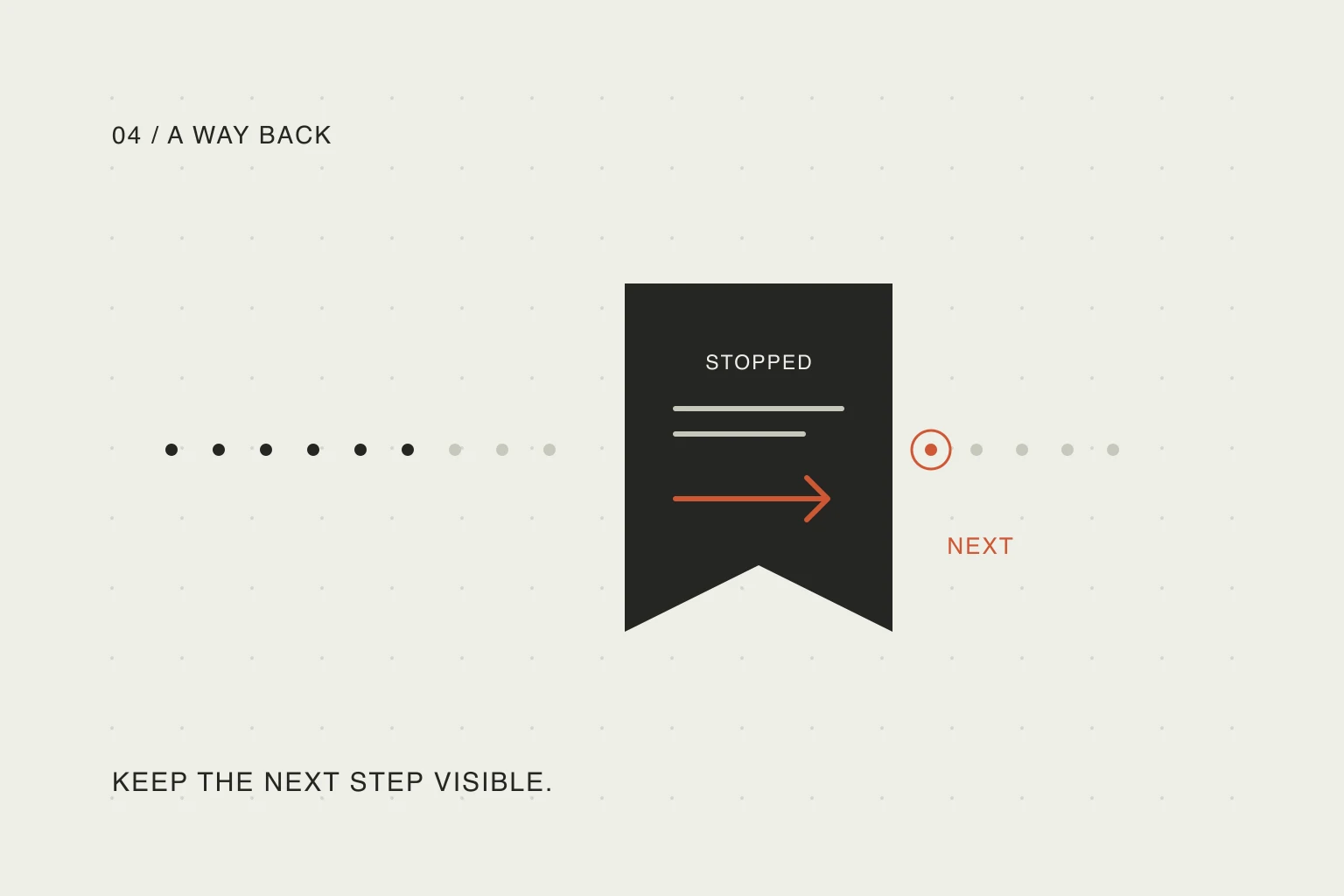
If you have a moment before leaving the task, write the detail you would otherwise need to reconstruct. Start with a single sentence. Add more only when it helps.
Scroll sideways to compare →
| Vague reminder | A useful return note |
|---|---|
| Finish proposal | Outline done. Check option B against the supplier quote; pricing table, row 4. |
| Continue packing | Clothes packed. Next: check charger and documents against the travel list. |
| Fix spreadsheet | Totals disagree. Compare the March entries with the source invoices before editing formulas. |
These are invented examples, not user records. Each captures a state you can verify and a visible action. None requires a detailed account of the previous hour.
Use this small template when you need a prompt:
Stopped at: [the last completed part]. Next: [one action]. Find it in: [file, page or physical place].
You can omit any part that is obvious. “Continue at the highlighted paragraph; verify the date first” may be enough. Keep the marker where you naturally return, rather than maintaining duplicate notes in several tools.
When the note itself is easy to forget
A useful return note has to be small enough to leave while you are working. In a discussion about recovering context after interruptions, Reddit user u/Ourglaz names a practical weakness of a separate note-taking habit:
Manual note-taking - I forget to write notes when I'm in flow
— u/Ourglaz, r/productivity.
This is one person's experience, not a measure of how often note-taking fails. It sharpens the design question: where can you leave a marker without opening another system? Try the document's next empty line, a comment beside the unfinished calculation, or a note attached to the current task. If the routine takes more effort than recovering the context, shorten it.
Understand what the evidence supports
Leroy and Glomb's 2018 study in Organization Science examined attention on the interrupting task when people expected time pressure on returning to unfinished work. Across four studies, a brief return plan mitigated the associated attention residue and performance cost. The paper's abstract is available online; full-text access may be restricted.
That distinction matters. The study does not establish a universal recovery time after every interruption, nor does it validate the three-part note above. We use the research as a reason to make returning explicit, while keeping the practical format small enough to use.
Jones and Moss examined a different question: whether practice resuming interrupted tasks transfers to novel tasks. Their study abstract on PubMed identifies retrieving the suspended next action as one possible transferable skill. These were controlled tasks, not a trial of a daily planner.
Neither study tests Nowrill. A useful personal test is narrower: after the next interruption, can you act on your note without searching through the whole task again?
Recover when there was no time to leave a note
Sometimes the interruption arrives without warning. Start from the state of the work you can see now. Open the document or inspect the partly finished object; find the last completed part and one unfinished part beside it.
For a spreadsheet, compare one row with its source before changing multiple formulas. For a half-packed bag, check the items against the list. For a draft, read the last finished paragraph and the heading that follows it.
If you cannot recover the next action, write the uncertainty itself: “Need to check whether the supplier price includes delivery.” Resolving that question is a usable next step. Guessing what you intended an hour ago is less reliable than inspecting what remains.
Once you have found a starting point, leave a marker if another interruption is likely. Do not spend the return period reconstructing a perfect history of the work.
Choose what fits in the time that remains
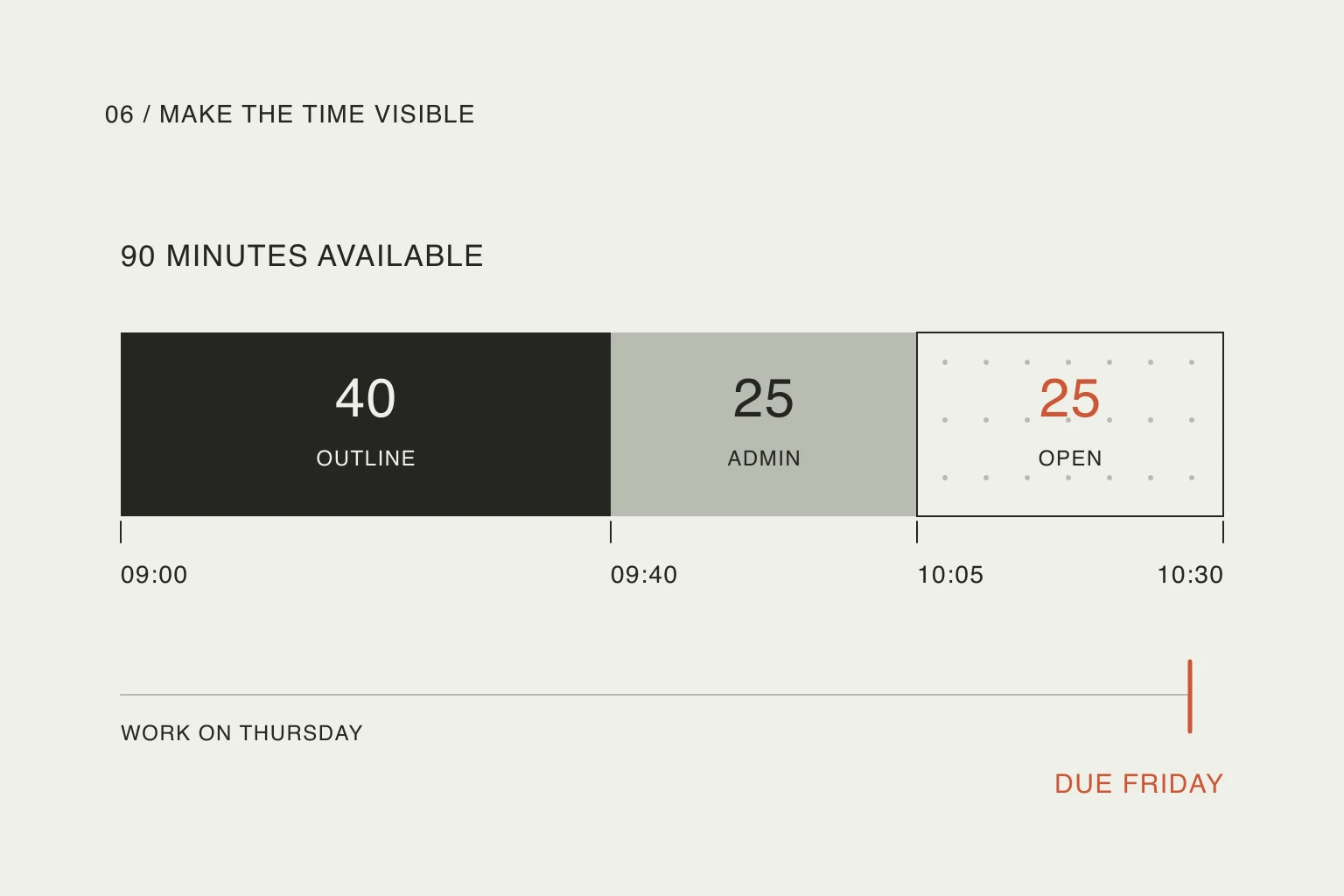
The task may be unchanged while the available time has shrunk. Before restarting, check your next fixed boundary: a meeting, a departure or the end of your working day.
With 15 minutes before leaving, checking one price may fit; rewriting the entire proposal probably will not. Choose between three actions: continue the next step, do a smaller useful part, or move the remaining work with its return note attached.
For example, “Check option B now; revise the wording tomorrow” makes both the immediate action and the later continuation clear. If several commitments are affected, use the guide to replanning the rest of your day to decide what can move.
Avoid treating every interruption as a reason to rebuild the whole day. Sometimes the only necessary change is a better starting point for one task.
Keep the return note with the task
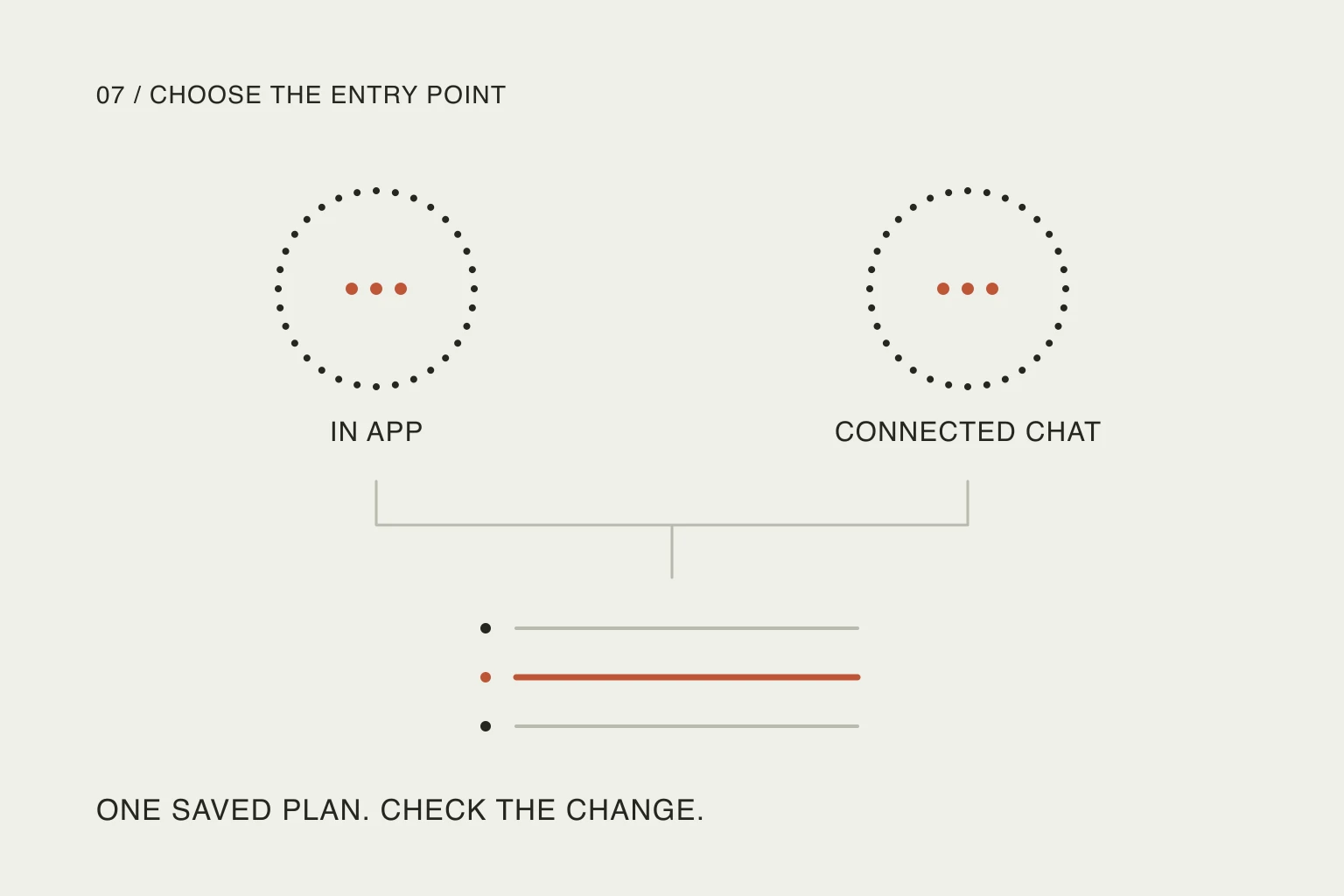
In the Nowrill web planner, task details include Resume from here. Save a short note there while keeping the task title readable. The title can remain “Draft proposal”; the note can name the paragraph, file or unresolved question.
For an edit through your connected external assistant, describe the exact change:
I was interrupted while drafting the proposal. Keep it unfinished. Add this return note: “Outline done; next, check option B against the supplier quote.” Move only this task to tomorrow. Preserve its other details and leave my appointments unchanged.
Check the saved date and note. If you use an explicitly opted-in timed session, pause it when you want the session clock to stop. Time passing does not establish that the task's outcome was achieved; a finished timer and a completed task mean different things.
Open the Nowrill web planner if keeping that point of return beside your daily task would help. Start with one task, and keep the note only as detailed as returning requires.
Useful resources
- Leroy and Glomb: original interruption study — the research behind the ready-to-resume intervention, including its scope. Abstract available; full text may require access.
- Jones and Moss: interruption resumption study — a freely readable abstract about transferring resumption skills between tasks, useful for understanding the role of retrieving the next action.
- Leroy and Glomb in Harvard Business Review — the researchers' workplace article; access may be restricted.
The note has done its job if it gets you to the next useful action. Shorten it when it becomes another task to maintain.